

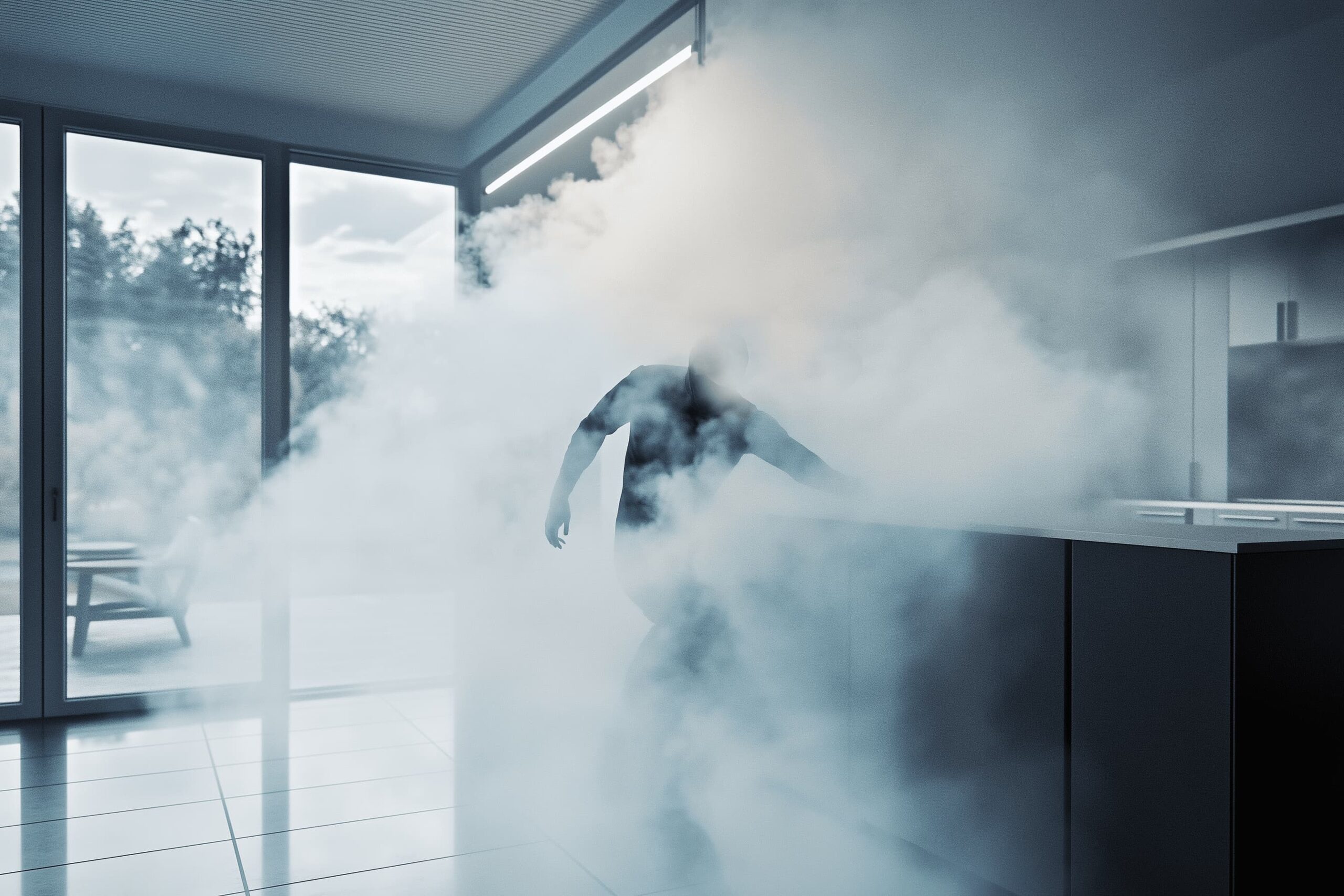
Un générateur de brouillard mal dimensionné, c’est une pièce qui ne se sature jamais complètement. Et une pièce qui ne se sature pas, c’est un cambrioleur qui continue d’avancer. Le choix du bon modèle ne dépend pas d’un budget ni d’une marque, il dépend avant tout d’un seul critère : la superficie à protéger.
La réponse courte : chaque modèle de la gamme Density® couvre une plage de surface bien définie, de 40 m² pour le Density Air jusqu’à plusieurs milliers de m² pour le HP14000 IP. Mais le m² n’est pas le seul paramètre. La hauteur sous plafond, le niveau de risque et le type de local entrent aussi en jeu.
This guide provides you with everything you need to choose the Density fog generator that’s right for your situation, without over- or under-specifying your protection.
Why floor space is the number one selection criterion
Un générateur de brouillard fonctionne en saturant l’espace d’un épais brouillard blanc opaque. L’objectif est simple : réduire la visibilité à zéro avant que l’intrus ait eu le temps de localiser quoi que ce soit. Pour y parvenir, le générateur doit produire suffisamment de m³ de brouillard pour remplir entièrement la pièce en quelques secondes.
Si la puissance est insuffisante par rapport au volume, le brouillard se dissipe avant d’atteindre les coins de la pièce. L’intrus conserve une zone de visibilité et peut continuer à agir. C’est précisément là que beaucoup de systèmes moins performants échouent : ils produisent un brouillard peu dense qui ne sature jamais complètement l’espace.
Le brouillard Density est 2 fois plus dense et 3 fois plus rapide que la moyenne des autres systèmes disponibles sur le marché. Cette performance est le fruit d’une turbo pompe brevetée et d’un liquide spécialement formulé. Mais même avec cette supériorité technique, un Density Air ne remplacera jamais un Density 900 dans un local de 80 m².
In short: the floor area determines the minimum power required. Below the saturation threshold, the system loses all its deterrent effect. Choosing a model with a slightly higher power rating than your actual floor area is always the right decision.
Buying guide: which Density model is best for which floor area?
Here is the complete cross-reference table for Density® models and the surfaces to be protected. This information is taken from the official technical data sheets.
| Model | Covered area | Fog generation | Maximum ceiling height | Typical use |
| Density Air | Jusqu’à 40 m² | 400 m³ in 45 s | 2.3 m | Households, small businesses |
| Density 390 | 5 to 40 m² of floor space | 390 m³ in 20 s | 2,5 m | Tobacco shops, small shops, ATMs, safes |
| Density 900 | 5 to 100 m² of floor space | 900 m³ in 29 sec | 3 m | Tobacco counters, secure storage rooms, high-value premises |
| Density 1500 IP | 80 to 200 m² of floor space | 1,500 m³ in 44 seconds | 4 m | Opticians, motorbikes, bicycles, medium-sized shops |
| Density 2400 IP | 150 to 300 m² of floor space | 2,400 m³ in 80 seconds | 5 to 6 m | Large retail outlets, small warehouses |
| Density HP6000 IP | Several hundred m² of floor space | 6,000 m³ in 80 seconds | 6 to 8 m | Large warehouses, logistics hubs |
| Density HP14000 IP | Several thousand m² of floor space | 14,000 m³ in 200 seconds | 6 to 12 m | Extra-large warehouses, industrial storage |
Density Air : la protection pour les espaces compacts (jusqu’à 40 m²)
Le Density Air est le modèle d’entrée de gamme de la gamme Density®. Il cible en priorité les particuliers et les petits commerces présentant un risque relatif. Sa force : un design compact disponible en 7 façades différentes (dont des modèles décorés), qui lui permet de s’intégrer discrètement dans un intérieur sans dénaturer la décoration. Il produit 400 m³ de brouillard en 45 secondes, ce qui suffit pour saturer complètement une pièce de 40 m² avec une hauteur sous plafond standard.
In practice, this model is ideal for a living room, a studio flat, an office or a small local shop. For rooms with higher ceilings or premises with a higher risk level, you will need to opt for the next model up.
Density 390: the standard for small shops and tobacconists (5 to 40 m²)
Le Density 390 couvre la même plage de superficie que le Density Air, mais avec un profil technique plus robuste : hauteur sous plafond portée à 2,5 m, buse multi-directionnelle, et surtout une certification EN50131-8:2019 et NF&A2P version 2019 cyber, les deux normes de référence sur le marché de la protection active.
C’est le modèle préconisé pour les tobacco shops, les petits commerces, les zones DAB ou les locaux coffre-fort. Il produit 390 m³ en seulement 20 secondes, ce qui en fait l’un des appareils les plus réactifs de la gamme pour sa catégorie.
En résumé : le Density 390 est le choix naturel pour les tabacs et petits professionnels qui ont besoin d’une certification complète. Son délai de saturation de 20 secondes est particulièrement adapté aux intrusions rapides.
Density 900 : jusqu’à 100 m² avec hauteur sous plafond de 3 m
As soon as the floor area exceeds 40 m² or the ceiling height approaches 3 metres, the Density 900 s’impose. Il produit 900 m³ de brouillard en 29 secondes, soit plus du double du modèle 390, pour une réactivité comparable.
Ce modèle est particulièrement adapté aux linéaires tabac (l’espace de vente principal), aux salles coffres, aux pharmacies, aux libres services bancaires et à tous les locaux contenant des produits à forte valeur jusqu’à 100 m². Il est lui aussi certifié EN50131-8:2019 et NF&A2P.
Do you provide security for a shop measuring between 40 and 100 square metres? Contactez le réseau d’installateurs Density pour obtenir un devis personnalisé.
Density 1500 IP and 2400 IP: for medium-sized retail premises (80 to 300 m²)
À partir de 80 m² et jusqu’à 300 m², deux modèles entrent en jeu. Le Density 1500 IP (80–200 m², height 4 m) is aimed at opticians, the motorcycle and bicycle shops, and medium-sized retail outlets. The Density 2400 IP (150–300 m², height 5–6 m) is designed for large retail chains, shopping centres and small warehouses with high ceilings.
Ces deux modèles disposent d’une carte IP haute sécurité native avec antenne Wi-Fi intégrée, permettant un pilotage à distance via le cloud Density. En pratique, cela signifie qu’un télésurveilleur peut tester, superviser et déclencher le système sans se déplacer.
Density HP6000 IP and HP14000 IP: the world’s most powerful warehouse solutions
The HP range offers a level of performance unrivalled on the market. The HP6000 IP covers several hundred square metres with ceiling heights of 6 to 8 metres, the HP14000 IP peut saturer plusieurs milliers de m² sous des plafonds allant jusqu’à 12 mètres, en produisant 14 000 m³ de brouillard en 200 secondes.
These models have been designed for logistics warehouses, les plateformes de stockage et les sites industriels qui ne pouvaient jusqu’ici pas bénéficier d’une protection active efficace. Un HP14000 IP remplace l’équivalent de 6 générateurs 2400 IP, avec une consommation électrique nettement inférieure à la somme de ceux-ci.
En résumé : les modèles HP n’entrent dans aucune norme existante (aucune norme ne couvre ces niveaux de puissance), mais ils sont les seuls à pouvoir saturer des volumes aussi importants en un temps opérationnel.
Intruder-repellent fog vs smoke: the differences that make all the difference
Intruder-repellent fog vs smoke: the differences that make all the difference
Un fumigène est un dispositif pyrotechnique à usage unique. Une cartouche, un tir, et c’est terminé. Si l’intrus déclenche à nouveau votre alarme ou si le système tourne à nouveau, rien ne se passe. Il faut aussi changer la cartouche à chaque déclenchement. Et surtout, les fumigènes laissent des résidus et des dépôts sur les surfaces, les tissus et les produits présents dans la pièce.
The Density fog system operates on a radically different principle. The cartridge is liquid-based, multi-shot, and has a shelf life of three years. Depending on the programmed firing time (adjustable to the second), each cartridge allows for between 3 and 12 activations. The mist produced is non-toxic, certified for use in food environments (FCMs certification, unique in the sector), and leaves no residue or marks on furniture, walls or clothing.
En termes de densité, le brouillard Density est 2 fois plus dense et 3 fois plus rapide que les fumigènes classiques. Ce n’est pas un argument marketing : c’est la conséquence directe d’une turbo pompe brevetée et d’une formule liquide optimisée.
En résumé : fumigène et brouillard ne jouent pas dans la même catégorie. Le fumigène est moins cher à l’achat, mais mono-tir, polluant et nettement moins efficace. Le brouillard Density est multi-tirs, non toxique, plus dense et certifié. Pour une protection professionnelle, la comparaison s’arrête là.
Other factors to consider in addition to floor area
La superficie est le point de départ, mais elle n’est pas le seul critère. Voici les quatre paramètres complémentaires à considérer avant de choisir votre modèle.
La hauteur sous plafond. Un local de 80 m² avec 4 mètres de plafond représente un volume de 320 m³. Le même local avec 2,5 m de plafond = 200 m³. Ce n’est pas le même appareil qui convient. Chaque modèle Density précise la hauteur sous plafond maximale pour garantir une saturation complète.
Le niveau de risque et les certifications exigées. Les assureurs et les organismes de certification exigent parfois des normes spécifiques. La gamme Density® (hors modèles Air et HP) est certifiée EN50131-8:2019 et NF&A2P version 2019 cyber. Cette dernière certification inclut la protection contre les attaques numériques, une exigence de plus en plus présente dans les appels d’offres professionnels.
The presence of foodstuffs. If your premises store or handle food products (bakery, restaurant, entrepôt agroalimentaire), Density est le seul générateur de brouillard sur le marché à disposer d’une certification FCMs autorisant son utilisation en milieu alimentaire. C’est un critère éliminatoire vis-à-vis des autres systèmes.
La connectivité et le pilotage à distance. À partir du Density 1500 IP, la carte IP haute sécurité est native et fournie avec antenne Wi-Fi. Elle donne accès au cloud Density pour superviser et tester le système à distance, sans intervention physique. Pour les locaux en réseau ou les télésurveilleurs qui gèrent plusieurs sites, c’est un avantage opérationnel décisif.
How does an anti-intrusion fog generator work? — Certifications and key features of the Density range
How many generators are needed for a room with a complex layout?
A simple rectangular room is easy to size. But an L-shaped space, a shop with alcoves or a warehouse divided into compartments raises a different question: do you need one or more generators?
D’après les retours terrain des installateurs du réseau Density, les espaces avec des cloisonnements importants nécessitent généralement un générateur par zone distincte. Une pièce de 150 m² ouverte peut être saturée par un seul Density 1500 IP. Ce même 150 m² découpé en trois zones séparées demandera probablement trois Density 390 ou 900, positionnés stratégiquement.
La buse multi-directionnelle présente sur la majorité des modèles certifiés permet d’orienter la diffusion du brouillard selon la géométrie du local. L’installateur Density procède systématiquement à une analyse de l’espace avant toute préconisation. Ce point est important : un mauvais positionnement peut compromettre l’efficacité du système même avec un modèle parfaitement dimensionné.
Conclusion
Choisir un générateur de brouillard, c’est d’abord dimensionner correctement la puissance au volume à protéger. La Density® range offers seven models covering areas ranging from 40 m² for the Density Air to several thousand m² for the HP14000 IP, with a maximum ceiling height that must not be exceeded in each case.
Au-delà du m², la hauteur sous plafond, les certifications requises, la présence de denrées alimentaires et le niveau de connectivité sont les quatre critères qui affinent le choix entre deux modèles proches. Et si votre local a une géométrie complexe, l’intervention d’un installateur du réseau Density reste le moyen le plus fiable d’obtenir une préconisation adaptée.
Contactez INNOV SÉCURITÉ pour obtenir une analyse gratuite de votre local et un devis sur mesure : le bon générateur de brouillard, c’est celui qui est calibré pour votre espace spécifique, pas un modèle universel.